Pic'n Go
A service ecosystem connecting restaurants, outdoor spaces and users through a picnic-based dining experience — designed during the Covid-19 pandemic
00

challenge
During the Covid-19 pandemic, Italian restaurants lost up to 60% of their seating capacity due to social distancing restrictions — with an estimated 8 billion euros in losses in 2020 alone. At the same time, tourists and locals were looking for safe, outdoor ways to enjoy quality food. The question: how do you turn a structural crisis for the restaurant sector into a new service opportunity?
solution
A platform connecting restaurants with outdoor park spaces through a picnic-based delivery service. Users order via app from local restaurants, a rider delivers a basket with food, blanket and biodegradable cutlery to a chosen park location, and a kiosk system handles waste collection and basket return. Restaurants recover lost capacity, users get a quality outdoor dining experience, and the service integrates entertainment features to extend the experience beyond the meal.
Pic'n Go demonstrated how service design can reframe a structural problem — lost indoor seating — as a new category of experience. By mapping the full service ecosystem across actor types and designing every touchpoint, the project established a model for context-responsive service innovation: using existing infrastructure (parks, restaurants, riders) to create a new experience that none of them could deliver alone.
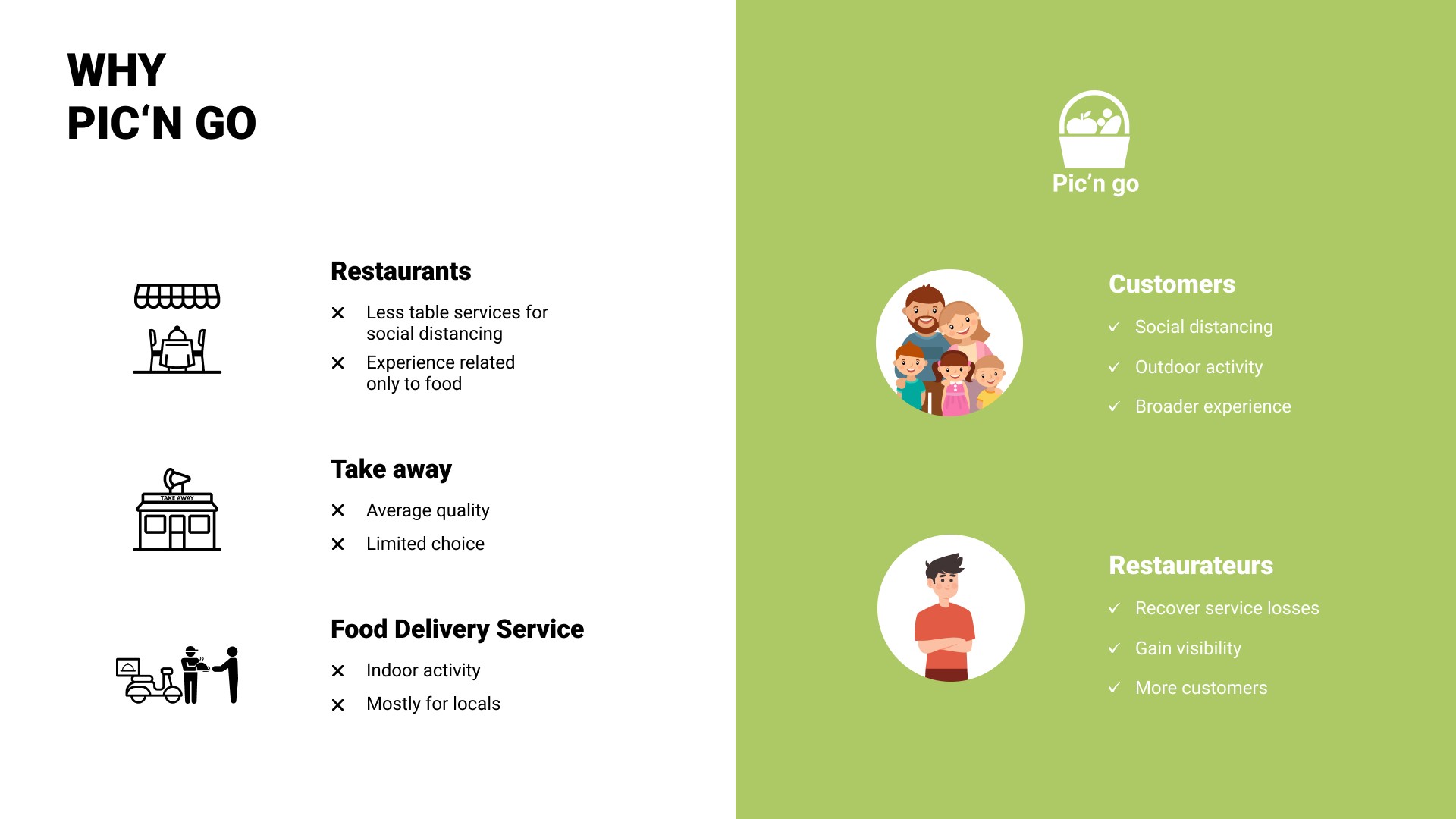
The service was designed for two distinct user types with complementary needs. Customers — families, tourists, groups of friends — gained access to quality restaurant food in outdoor settings, with safety and entertainment built in. Restaurateurs gained a new revenue channel to recover losses from reduced indoor capacity, without requiring physical expansion or infrastructure investment. The service architecture had to serve both simultaneously without compromising either.
Sustainability was embedded in the service logic from the start. Biodegradable cutlery, a kiosk-based return system for baskets and blankets, and a cleaning and redistribution loop managed by a dedicated logistics team made circularity a structural feature of the service — not an add-on. Users received an in-app prompt to recycle before leaving the park, closing the loop at the customer touchpoint level.
01
Market Analysis
Understanding the crisis
Quantitative analysis of the Covid-19 impact on the Italian restaurant sector — 60% seating loss, 8 billion euros estimated loss, 22% of tourist spending in Italy directed at food and restaurants. The crisis framed the opportunity: a structural constraint (no indoor dining) could become a new service category (outdoor dining) if the right ecosystem was designed around it.
02
Stakeholder & Offering Mapping
Who is in the system
Full stakeholder map across internal and external actors — users, restaurateurs, riders, municipalities, gadget suppliers, payment platforms, cleaning services, logistics team. Offering map defining what each actor gives and receives within the service. The mapping revealed that the service required five distinct operational tracks running simultaneously.
03
Customer Journey
Before, during, after
Full journey mapped across eleven steps — from discovery in the park to recycling and review. Two personas developed: a family of tourists discovering Pic'n Go while walking in Parco Sempione, Milan; a group of local friends looking for a safe outdoor lunch option. Every touchpoint — app screens, basket, blanket, rider notification, kiosk — designed to support the journey at each step.
04
System Map & Service Blueprint
Making the invisible visible
System map documenting material flows, cash flows and information flows across all actors. Full service blueprint across four operational layers: customer actions, platform actions, rider actions, restaurateur actions — with lines of interaction, visibility and internal interaction explicitly mapped. The blueprint revealed where coordination between actors was most critical and most fragile.
year
2019
Client
Academic Project, Politecnico di Milano


see also